
Nile Cruise vs Land Viewing for the 2027 Eclipse
Compare mobility, cloud avoidance, comfort and crowd management when choosing a Nile cruise or land-based site for Egypt’s 2027 total solar eclipse.
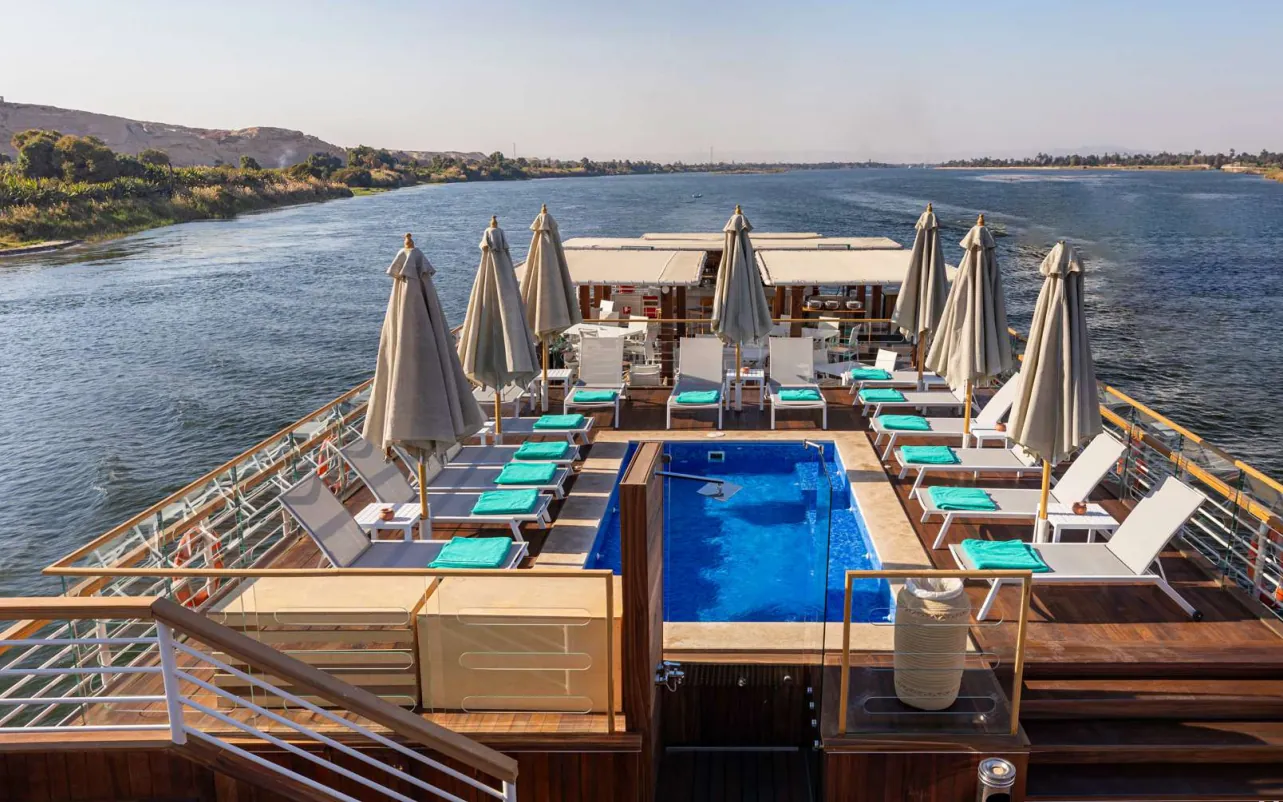
Choosing between Nile cruise vs land viewing for the 2027 eclipse is less about whether a ship or hotel provides the better view and more about how each arrangement handles logistics. On 2 August 2027, totality over Luxor will last about 6 minutes 23 seconds, making this the longest total solar eclipse visible on land between 1991 and 2114. Both approaches can place travellers within the eclipse path, but they differ substantially in mobility, comfort, crowd exposure and access to alternative observing locations.
Nile cruise vs land viewing for the 2027 eclipse
A Nile cruise offers an integrated journey: accommodation, meals, transport and sightseeing are organised around a single vessel. A land-based stay normally uses a hotel in or near Luxor, with road transfers to a selected viewing site. The decisive issue is not the accommodation itself, but the quality of the eclipse-day plan.
Cruise passengers should not assume that observation will necessarily take place from a sailing vessel. River traffic, mooring permissions, bankside obstructions and the position of the Sun may make a carefully selected land site preferable. Equally, a land itinerary is not inherently fixed if it includes vehicles, alternative sites and experienced local coordination.
The practical comparison is therefore between an organised cruise-based expedition with access to shore and a land programme capable of moving its guests efficiently.
Mobility and cloud avoidance
Upper Egypt is noted for generally dry summer conditions, but no operator can guarantee clear skies. Local haze, dust or isolated cloud can still affect visibility. Mobility is consequently valuable, although it must be understood realistically.
A cruise provides broad itinerary flexibility before and after eclipse day. It can position guests along different parts of the Nile corridor, subject to navigation schedules and permissions. On the morning itself, however, a river vessel is slower and less directionally flexible than road vehicles. It cannot simply travel across country towards a clearer sector.
A well-run cruise expedition therefore combines the vessel with a land transport plan. Coaches or smaller vehicles can move observers from the mooring to a prepared site, while forecasts and local reconnaissance inform the final choice. This arrangement preserves the convenience of travelling by ship without treating the ship as the only possible observing platform.
Land-based viewing can offer greater road mobility if several viable sites have been secured in advance. Its limitations are traffic, road capacity, parking and the number of other groups attempting the same move. A theoretical backup site is of little value if thousands of people leave Luxor at once or access is restricted.
When assessing either format, ask:
- Is there a primary observing site and at least one credible alternative?
- How late can the final site decision be made?
- Are vehicles reserved exclusively for the group?
- Have access, parking and land permissions been arranged?
- Will astronomical and local operations teams communicate directly?
- Is the plan designed around realistic travel times rather than map distances?
Comfort during an August eclipse
Luxor in August is extremely hot, and the partial phases extend the time spent outdoors well beyond the 6 minutes 23 seconds of totality. Shade, water, seating, toilets and medical support matter as much as an unobstructed horizon.
Cruise accommodation provides an air-conditioned base, a private cabin and established catering. Guests can rest before and after the event without packing and changing hotels. This is particularly useful on a longer Egyptian itinerary, where repeated transfers can be tiring.
The 9-Day Nile Eclipse Odyssey aboard MS TIA is the primary option for travellers seeking a nine-day cruise framework with the eclipse incorporated into the wider Nile journey. Its published price starts from $6,990. Travellers should still review the detailed arrangements for the observing site, shore transfers and eclipse-day facilities rather than judging suitability solely by the vessel.
A hotel can provide comparable air-conditioned comfort, especially if it is close to the viewing area. The weakness arises when guests must check out, travel early, wait in an exposed location and then return through heavy traffic. A good land programme will arrange shaded areas, ample drinking water, suitable toilets and seating at the site rather than relying on nearby public infrastructure.
Crowds and site control
Luxor’s long totality will attract international visitors as well as Egyptian spectators. The busiest areas are likely to include prominent archaeological surroundings, major roads, hotel districts and easily reached open ground. Crowds can create noise and obstruct sightlines, but the more serious concerns are delayed transfers, inadequate facilities and unmanaged vehicle access.
Cruise groups benefit from controlled passenger numbers aboard their vessel. That advantage does not automatically extend to shore. A private or access-controlled observation area is preferable to an informal public riverbank, where trees, buildings, moored boats or late-arriving spectators could compromise the view.
Smaller vessels can offer a more intimate experience. The Cleo Dahabiya · Nile Eclipse Expedition runs for 10 days and starts from $8,739. A dahabiya may appeal to travellers who value a smaller-scale Nile journey, although its eclipse-day resilience still depends on transport, site access and contingency planning rather than vessel size alone.
Land viewing can also be tightly controlled if the operator has secured a sufficiently large private site. Conversely, a nominally exclusive location may become congested if several organisations share the same access road. Ask about both the number of people at the site and the number using the surrounding infrastructure.
Which option suits different travellers?
Choose a cruise-based expedition if:
- You want accommodation, meals and Nile sightseeing combined in one itinerary.
- You prefer to unpack once and minimise hotel changes.
- You value an air-conditioned base before and after eclipse day.
- You want an organised group structure with planned shore transport.
- The wider journey through Upper Egypt is an important part of the trip.
The 9-Day Nile Eclipse Odyssey aboard MS Q, from $4,690, offers another nine-day cruise option. Comparing it with MS TIA should include cabin style, vessel atmosphere and the operational details of eclipse day, not price alone.
Choose land-based viewing if:
- Your priority is maximum road flexibility between pre-arranged sites.
- You prefer a particular Luxor hotel or a shorter local stay.
- You are comfortable with daily transfers and possible traffic delays.
- Your programme has demonstrably secured private sites, vehicles and facilities.
- You do not want the cultural itinerary or pace of a Nile cruise.
Independent land viewing may appear flexible, but it transfers responsibility for access, navigation, heat management and crowd avoidance to the traveller. Roads may be busy, familiar-looking open areas may be private or unsuitable, and last-minute movement can be counterproductive. For most visitors, an organised land programme is safer operationally than hiring a vehicle and searching for clear ground on eclipse morning.
What matters more than cruise or land
The strongest option is the one with specific answers to operational questions. Look for evidence of astronomical planning, local permissions, professional transport and realistic alternatives. Protective eclipse glasses must be used during the partial phases; direct naked-eye viewing is safe only during totality, when the Sun is completely covered, and eye protection must be replaced as soon as the bright solar surface reappears.
Cruise and land arrangements should also account for heat exposure, mobility needs and the possibility that a guest cannot stand for long periods. Travellers with health or accessibility concerns should confirm walking distances, vehicle boarding arrangements, shade and toilet provision before booking.
For many visitors, a cruise-based expedition offers the better balance: the comfort and continuity of a Nile vessel combined with transport to a deliberately chosen observing site. Land viewing may provide stronger last-mile mobility, but only when multiple sites and the routes between them have been secured in advance.
Review the full range of 2027 eclipse tours to compare vessel style, duration and inclusions. If your decision depends on accessibility, cabin requirements or detailed eclipse-day logistics, contact our Egypt travel team before selecting an itinerary.