
Dahabiya Nile Cruise vs Traditional Cruise Ship
Compare dahabiyas and conventional Nile ships by size, pace, comfort, access and eclipse suitability before choosing your Egypt cruise.
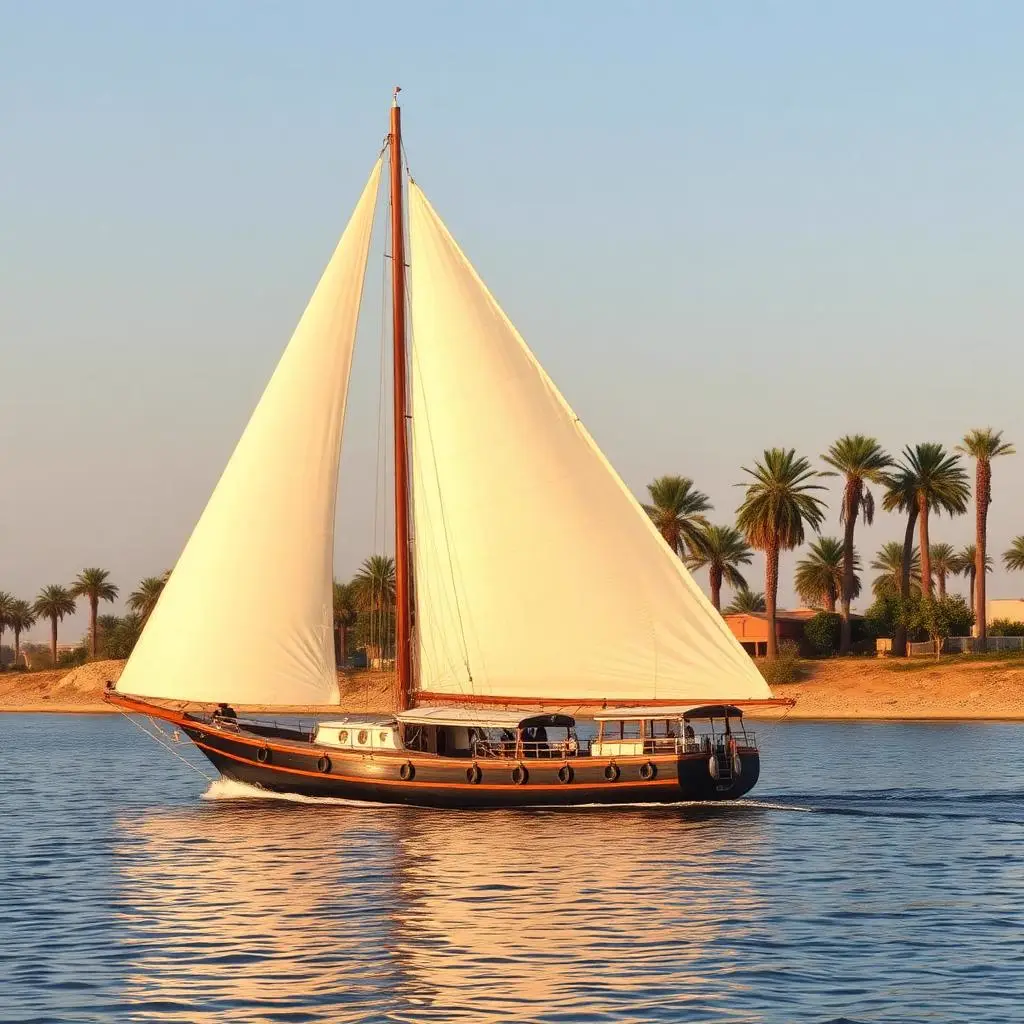
Choosing between a dahabiya Nile cruise vs traditional cruise ship is less about deciding which vessel is universally better and more about matching the journey to your preferred pace. A dahabiya offers a smaller-scale, quieter experience with closer contact with the river, while a conventional Nile ship generally provides more facilities, greater cabin choice and a livelier social setting. Both can form part of an eclipse journey centred on Luxor, where the total solar eclipse of 2 August 2027 is expected to last about 6 minutes 23 seconds.
Dahabiya Nile cruise vs traditional cruise ship: the essentials
A dahabiya is a shallow-draught sailing vessel traditionally associated with leisurely travel on the Nile. Modern versions retain the broad deck, twin lateen sails and intimate proportions, although engines or support craft may assist when wind and river conditions require. Passenger numbers are usually much lower than aboard a conventional cruise ship.
Traditional Nile cruise ships are larger, powered vessels built to carry more guests between the principal Upper Egyptian ports. They normally have several passenger decks, a restaurant, reception, lounge and sun deck. Some also offer a pool, bar, spa services or evening entertainment, although facilities vary considerably by vessel.
The practical distinction is therefore small and unhurried versus larger and more fully equipped. It should not be reduced to sailing vessel versus motor vessel, because a dahabiya's progress still depends on operational conditions and its published programme.
Atmosphere and passenger numbers
Dahabiyas appeal to travellers who value privacy, quiet decks and a less institutional style of service. With fewer guests, meals and shore visits tend to feel more personal. The open deck often becomes the centre of life aboard, used for dining, reading and watching the cultivated banks pass at close range.
A traditional ship has a more recognisable cruise atmosphere. There are more fellow passengers, larger shared areas and a structured daily rhythm. This can suit sociable travellers and groups who enjoy meeting others. It also provides more scope to withdraw to an indoor lounge when the heat is pronounced.
Neither format guarantees silence. Dahabiyas may moor near villages, other vessels or river traffic, while larger ships can experience engine noise and busy docking areas. Cabin position matters on any vessel, so ask about proximity to engines, generators, stairways and communal spaces.
Cabins, facilities and accessibility
Traditional ships generally offer more cabin categories and hotel-style infrastructure. Depending on the vessel, that may include lifts, larger public rooms, climate-controlled lounges and a pool. Cabins are typically arranged across several decks, though their size and outlook differ.
Dahabiya cabins tend to be limited in number and may be compact. Their attraction lies more in the vessel's character and generous deck space than in an extensive list of amenities. Air conditioning, private bathrooms and cabin configurations should always be checked against the specific boat rather than assumed.
Travellers with reduced mobility should examine both options carefully. A larger ship may have lifts, but gangways, steep riverbanks and mooring alongside other vessels can still present obstacles. Dahabiyas are smaller but often rely on steps and simple boarding arrangements. Discuss individual requirements before booking through our travel planning team.
Route, pace and shore access
Most conventional cruises operate between Luxor and Aswan, calling at major archaeological sites such as Edfu and Kom Ombo. Their greater speed helps them follow regular schedules, but popular calls can coincide with other ships and create busy periods ashore.
A dahabiya's shallow draught and smaller size can permit stops at quieter riverbank locations that large ships cannot use readily. Longer itineraries may also reach places beyond the standard Luxor–Aswan corridor. The 10-Day Cleo Dahabiya · Sohag & Abydos Extended, for example, incorporates Sohag and Abydos, while the 9-Day Cleo Dahabiya · Luxor to Aswan Classic follows the classic Upper Nile direction.
Weather, navigation requirements and local permissions can affect any river itinerary. A dahabiya should not be chosen solely on the expectation of travelling under sail throughout or making unscheduled landings.
Dining and service
On a dahabiya, guests commonly eat together at one table or in a compact dining area. Menus are often served at set times, and the smaller galley naturally limits the breadth of choice. The benefit is a convivial, house-party quality and closer interaction with the crew.
Traditional ships can support larger restaurants and broader buffets, although service style varies. They are generally better suited to travellers who prefer more choice at each meal or want separate lounges and bars.
Dietary requirements can be handled on either type when notified in advance, but highly restrictive diets deserve detailed discussion before confirmation. Smaller vessels have less storage and fewer alternative outlets if a requested ingredient is unavailable.
Which vessel works better for the 2027 eclipse?
The observation arrangements are more important than the vessel category. The 2 August 2027 total solar eclipse passes over Luxor, with about 6 minutes 23 seconds of totality there. That exceptional duration is the longest total solar eclipse visible on land between 1991 and 2114.
A dahabiya's limited passenger complement and open deck may sound ideal, but observation should not be assumed to take place from the boat. A dedicated land site may provide a wider horizon, firmer ground for tripods and better-controlled access. Larger-ship itineraries can likewise transfer guests to a planned viewing location.
When comparing eclipse programmes, establish:
- Where observation is scheduled and how guests reach the site
- Whether the horizon is unobstructed
- How transport, water, shade and toilet facilities are managed
- What contingency planning is in place for local conditions
- Whether certified eclipse viewers are included or must be obtained separately
- How much time the itinerary allocates to Luxor before and after eclipse day
For travellers who favour a conventional vessel, the 9-Day Nile Eclipse Odyssey · MS Q and 9-Day Nile Eclipse Odyssey · MS TIA provide contrasting ship-based options. Those drawn to small-vessel travel can also compare the 9-Day El Hanem Dahabiya · Aswan to Luxor, which reverses the usual direction of some programmes.
Advantages and compromises at a glance
Choose a dahabiya if you prefer
- A small guest complement and a more intimate atmosphere
- Long periods on an open deck close to the river
- A slower rhythm and potential access to quieter moorings
- Shared meals and personal interaction with the crew
- Character and simplicity over numerous onboard facilities
Choose a traditional ship if you prefer
- More cabin categories and substantial indoor public spaces
- Facilities such as a lounge, bar or pool, subject to the vessel
- A larger and more sociable passenger environment
- Powered navigation and a more standardised cruise pattern
- Greater menu breadth and hotel-style operation
Cost and value
Dahabiyas are not necessarily the cheaper choice. Their small capacity means operating costs are divided among fewer guests, and a private or highly serviced vessel can command a premium. Traditional ships cover a broad range, from straightforward accommodation to luxury products.
Compare what is included rather than relying on the headline fare. Look at transfers, guiding, site admission, drinks, gratuities, eclipse arrangements and pre- or post-cruise hotels. Direction and duration also matter: an extra night may allow a calmer schedule or an additional archaeological site.
Making the final choice
Choose a dahabiya for intimacy, river scenery and a measured pace; choose a traditional ship for broader facilities, greater cabin choice and a more conventional cruise environment. For eclipse travel, give equal weight to the land arrangements around Luxor and the observation plan.
Our complete range of Egypt eclipse tours and Nile cruises allows you to compare both styles. If the small-vessel experience is the priority, begin with the 9-Day Cleo Dahabiya · Luxor to Aswan Classic; if onboard facilities carry more weight, review MS Q or MS TIA before deciding.